.png)
Flow Wing
Sensible tuning for your aero road, gravel and track bike.
Maximum aerodynamics combined with noticeable comfort.

Why develop your own handlebar?
What if there are already hundreds of models on the market?
The answer is simple:
Because we couldn't find a handlebar with...
-
effective improvement of aerodynamics,
-
Well-designed, field-tested ergonomics,
-
Handlebars should not be too wide,
-
not too little but also not too much rise (increase),
-
easy-to-install cable duct,
-
meaningful (UCI-legal) flare and
-
the possibility of mounting an aero extension or other accessories.
For us, the cockpit – besides tires and gearing – is the heart of the bike.
It determines control, balance, and how the wheel feels.
Our idea
We were looking for the perfect road bike handlebar that combines aerodynamics, ergonomics, damping and ease of maintenance – and since we couldn't find one, we developed it ourselves.
From a racing driver for racing drivers.
Whether on perfect asphalt or rough gravel, the Flow Wing must offer control, allow you an aerodynamic position, and feel comfortable in all hand positions.
In addition, the handlebars should have a rise (lift) and a small drop (depth in the lower section) to make your bike more comfortable, or alternatively, to allow you to use fewer spacers and make your road bike look sportier with the same handlebar height.

Details about our ideas and innovations

Der leichte Knick an dieser Stelle gibt der Hand eine sichere Griffposition im Unterlenker und unterstützt den festen Halt beim Bremsen.

Sieht nur unbedeutend aus, ist aber eine Wohltat für den Mittelhandknochen. Dort liegt viel Gewicht und durch die Abflachung verteilt sich das besser auf die Knochen.

Hier eine Ansicht, mit der du die seitliche Form siehst. Nicht nur die Profile ändern sich, sondern auch die Linienform. Das hat nichts mehr mit einem Lenker aus Aluminium zu tun.
Der leichte Knick an dieser Stelle gibt der Hand eine sichere Griffposition im Unterlenker und unterstützt den festen Halt beim Bremsen.
Image gallery. Use the inner arrows to switch between images. Click on an image to enlarge it.
.jpg)
Development
The Flow-Wing is not simply a new handlebar -
It is the further development of the proven Cross-Wing.
Over a period of 14 months, we developed more than 40 versions and produced 30 prototypes using a 3D printer for testing and optimization.
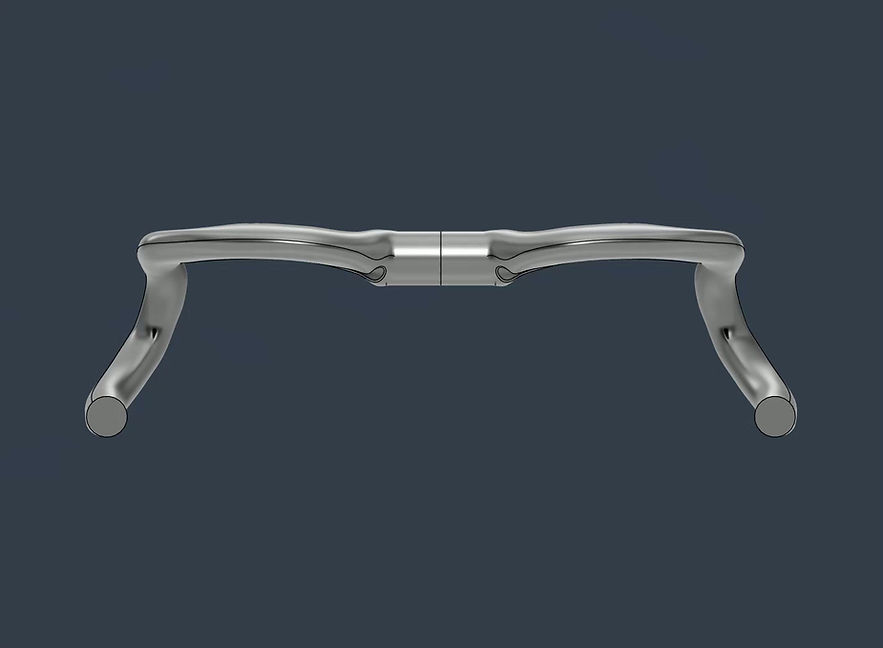
The innovation lies in the details. To guarantee the most comfortable grip position for every hand position, the handlebar consists of 20 different profiles per side.
That's why the handlebar is comparable to an airplane wing and is called the " wing ".
The addition of " Flow " comes from the perfect and tactile feel that is "addictive".
Anyone who has the handlebars in their hands will immediately feel the difference.
What else was important to us?
-
Freedom of form : We wanted to design the handlebars to be as free and perfect as possible, as required for our aerodynamic and ergonomic needs.
-
Ergo-Drops: With a small drop of only 93mm, you can comfortably grip the drops without sitting too low.
-
Damping : The Flow-Wing uses a blend of T800 and T1000 carbon (reinforced with Beskar steel fibers 😉) to effectively absorb vibrations. The flattened top link acts like a leaf spring, absorbing shocks from the front wheel and providing vibration damping, which is especially important when gravel riding.
-
Weight : At 230g, it's not the lightest weight, but it does make the handlebars suitable for gravel bikes. Experience has shown that this is a good compromise, and the handlebars survive most crashes unscathed.
-
Innovation : The deep cable duct is an innovation and has not been implemented anywhere before. This is also one reason for the long development time. We are proud of it and now know that it was worth it.
.jpg)
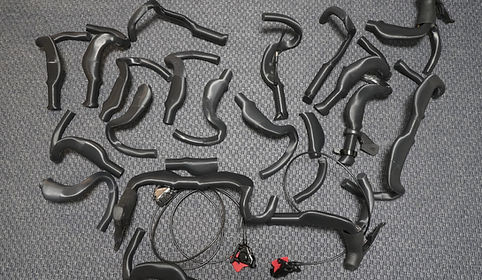


We deliberately chose to reject trends that would bring disadvantages in practice:
-
No integrated stem unit : Combined units are inflexible, expensive, and a total loss in the event of a crash. We prefer a practical solution that remains individually adjustable.
-
Safety in the peloton : Many gravel handlebars flare out in a V-shape. This is dangerous in groups (risk of entanglement). Our drops offer 58mm of flare for control, but the ends run parallel (no outsweep).
-
Maintenance-friendliness : Fully integrated cables often make handlebar swapping a nightmare. Our open cable channel under the top of the handlebar allows for quick changes without bleeding the brakes – ideal for racers and mechanics.
Here is the result


Image gallery. Use the arrows to switch between images. Click on an image to enlarge it.
The flared design for a wider grip on the drops is advantageous off-road and during sprints. The significantly narrower width at the brake levers allows for a particularly aerodynamic position. The ergonomic hand rest on the tops is especially helpful when climbing and riding at a relaxed pace.
The 32/39 cm and 34/41 cm versions are our handlebars designed specifically for aero road bikes, featuring a 48 mm wide clamping area for the stem. We offer mounts for Garmin and Wahoo bike computers that attach to the stem.
The 33/40 cm version is modified and is our "universal handlebar". The clamping area is 85 mm wide, allowing for the mounting of speedometer and light mounts, aero extensions, a bell, additional brake levers from the Shimano GRX group, or handlebar bags. This handlebar therefore offers many possibilities that no other aero handlebar provides.
We also recommend this width for all gravel cyclists . The width is a good compromise, and when riding on the tops, the hands are further apart, providing more stability. Additionally, there's room for a bell next to the stem, which is practically essential on forest trails.
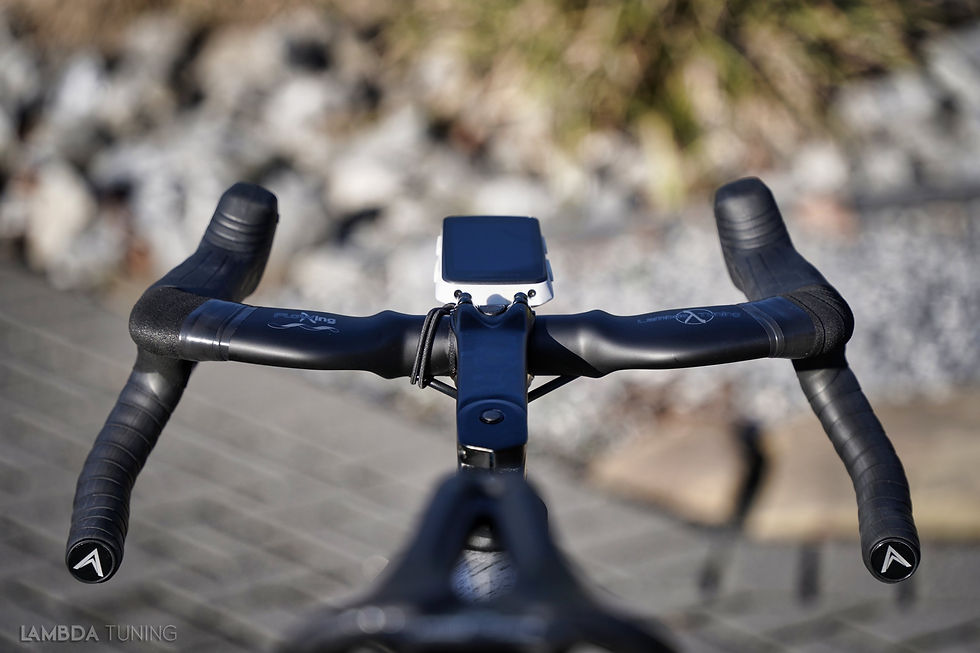
One handlebar for everything – road, gravel and track
Another highlight is the versatility of the Flow-Wing.
-
Road : For those seeking an aggressive, narrow aero position and wanting to save watts.
-
Gravel : With a 58 mm flare per side, the Flow-Wing offers massive leverage on technical terrain. The Flow-Wing utilizes a blend of T800 and T1000 carbon to effectively absorb vibrations. The flattened top section acts like a leaf spring, absorbing shocks from the front wheel.
-
Specifically for racers : The parallel handlebar end (no outsweep) prevents getting tangled up with competitors in a dense peloton or during criteriums.
-
Time trials, long-distance riding, and bikepacking : The 33/40cm version is a problem solver. With a clamping area of 85 mm, the handlebar offers space for aero bars, lights, computers, or handlebar bags – ideal for ultra-endurance events or time trials.
-
On the track : In the 39 cm version, the width at the hoods shrinks to a narrow 32 cm. In mass-participation track events, this is a significant advantage: You are not only more aerodynamic at speeds of 50+ km/h, but also more maneuverable in a dense field.
The future of the cockpit is modular and narrow.


Image gallery. Use the arrows to switch between images. Click on an image to enlarge it.
Narrower profile for minimal frontal area.
This way you save energy where it counts: in the wind.
For many cyclists, aerodynamics is everything. The Flow-Wing handlebar was specifically designed for inward-facing brake levers. This position with this handlebar is not only UCI-legal, but also saves you a good 20 watts at 40 km/h compared to conventional drop handlebars.
-
Aero-Hood Position: Your arms and hands form a streamlined line, similar to a time trial bike boom.
-
Natural ergonomics: The slightly inward-turned posture corresponds to the natural position of your hands.
"Don't fight the wind. Flow with it."
I have an aero simulator that you can use to adjust the aero hood position. Hoods are typically mounted 24cm apart. The simulator calculates a gain of 21 watts. This corresponds well with reality (a 23-watt difference compared to a 40cm wide handlebar).
.jpg)
Here is an excerpt from the UCI rulebook. The image shows that the 10° inward rotation of the brake levers is measured relative to the handlebars and not to the direction of travel.
The 28cm internal width must still be adhered to.

Aero and Geometry Simulator
Technical requirements
-
Electronic radio circuit
-
Hydraulic or mechanical brakes
-
Integrated or exposed brake lines
-
For a stem width over 50mm, the 34/41cm handlebar is suitable.
The Cross-Wing remains in the product range and is suitable for racing bikes that still have a mechanical shifting system.
Technical data
Handlebar widths: see images above
UCI legal
Weight: approx. 230g *
Drop: 93mm
Reach: 75mm
Flare: 58mm per side (approx. 20°)
Maximum rider weight: 120 kg **
Backsweep: approx. 20mm extension at the top link to the rear
Stem and accessory clamp: 31.8mm
Carbon design: matte black with printed logo and glossy decor
ISO 4210 certified: Approved for road and gravel racing bikes
* Weight specification based on our own measurements and may vary by up to 5g due to manufacturing variations.
** Driver plus clothing and backpack
Tips for cyclists
For those who truly (!) require a 28cm distance between the brake levers for high-level UCI races, we recommend the Flow Wing in the 34/41cm version. This ensures the brake levers maintain an ergonomic and aesthetically pleasing inward angle. With the narrower 32/39cm version, they must be adjusted almost straight forward (see the following images).
.png)
34/41cm handlebars with a 28cm distance between the brake levers

32/39cm handlebars with a 28cm distance between the brake levers
For racers who also want to do a time trial from time to time, we recommend the 33/40cm TT version.
There are many good reasons to mount an aero extension on a classic racing handlebar.
Reduction of air resistance
The biggest advantage is the aerodynamic optimization. The attachment allows you to bring your arms close together and your upper body into a low position, significantly reducing your frontal area. The result: with the same wattage output, you achieve considerably higher speeds – often a gain of 2 to 3 km/h.
Relieving the muscles during long-distance running
Comfort plays a particularly important role over long distances. Instead of laboriously supporting your weight with your arm and shoulder muscles, your forearms rest stably on the pads. Your upper body can relax while you efficiently transfer your full power to the pedals.
Maximum versatility
A high-quality setup can replace a dedicated time trial bike in many cases. Even though it sounds bold: I use a road bike with aero bars even in duathlon competitions and have been able to replace my time trial bike with it.
An interesting test by the magazine RennRad in the wind tunnel supports this: There, a time trial bike showed over 6 watts more resistance at 45 km/h than an aero racing bike (without a rider).
The reason: A time trial bike only "works" aerodynamically in conjunction with the rider in the aero position. If I now equip my aero road bike with aero bars, the difference is minimal with an identical riding position.
The decisive advantage for me: I can ride my usual bike all the time and don't have to painstakingly get used to a completely new geometry just before the competition.
Tip:
For more in-depth information, feel free to check out my blog on the perfect aero position .


Image gallery. Use the arrows to switch between images. Click on an image to enlarge it.
Downloads & Links
Inwardly angled brake levers have the following advantages
On the lower link:
The brake and shift levers are easier and faster to reach, as the fingers need to be stretched less to access the brake lever. Furthermore, the position of the brake and shift levers is more comfortable and, with flared handlebars, parallel to the direction of travel.
On the brake levers:
Here, the hand is slightly turned inwards. This is the natural position of the hand when it is (relaxedly) extended forward. Rotation outwards or straight forward is unnatural.
The brake and shift levers are also easier to operate. It is particularly important to hold the brake levers firmly and brake simultaneously on bumpy surfaces.
At the brake lever humps (aero-hood position):
A highly aerodynamic position is achieved by holding onto the inwardly angled brake hoods and resting the forearms on the tops of the handlebars. Essentially, this is a similar position to riding with aero bars. The flat tops of the handlebars make this comfortable and offer the advantage of very quick access to the brakes. This isn't possible with extensions. Aero tests demonstrate a significant reduction in power output of approximately 23 watts at 40 km/h with this setup compared to a standard 40cm wide drop handlebar.
Also try out our Aero Simulator .
_jp.jpg)
_jp.jpg)
_jp.jpg)
At the upper position nothing changes. The aerodynamics caused by the brake handles being turned inwards are only minimally impaired and disproportionate to the aerodynamic gain due to the new posture and improved ergonomics.
You see – many advantages and almost no relevant disadvantages. Basically all hand positions remain identical. The new shapes of the Shimano and SRAM brake levers also support this mounting position. Just test it yourself. You get used to the new look within 2-3 rides and you don't want to be without the improved feeling.
Video of the construction